
Mathematics Can Describe Any Reality. Physics Chooses Which One Is Ours.

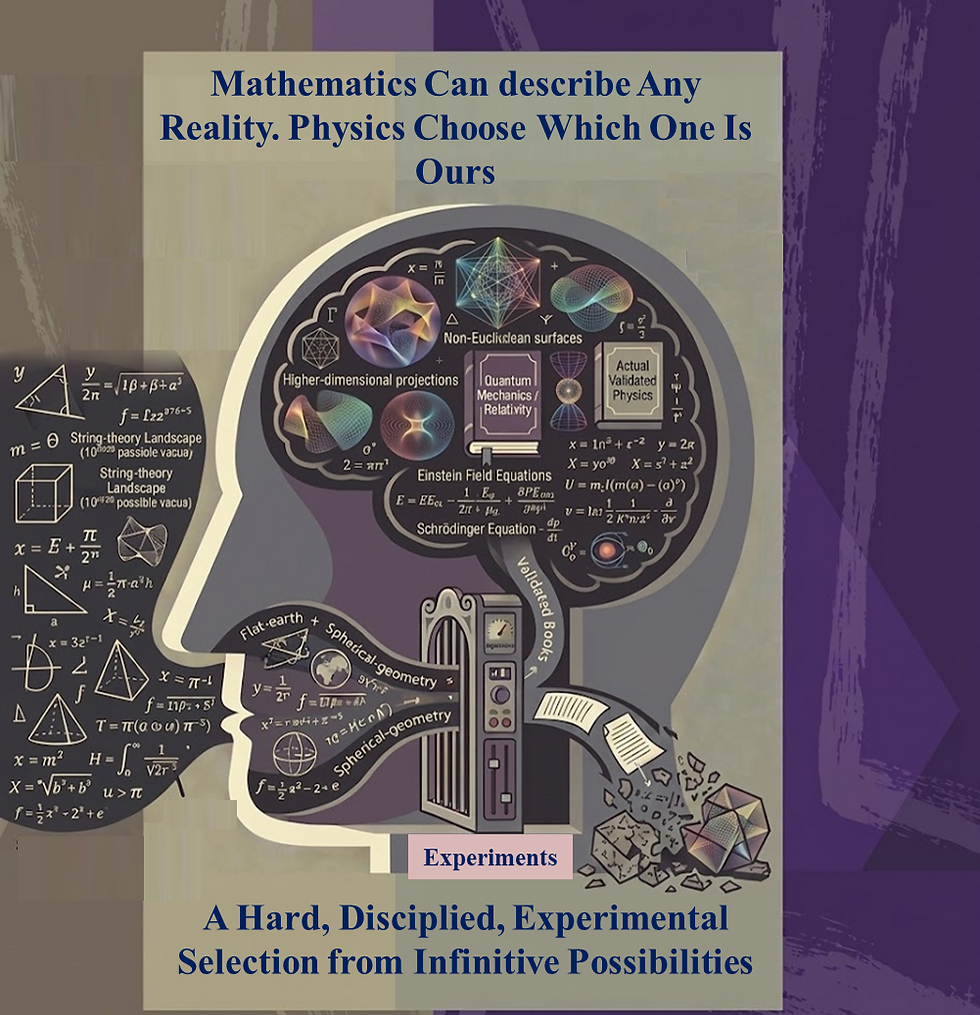
The "unreasonable effectiveness" of mathematics isn't a mystery. It's a selection process obscured by survivorship bias — and confusing the two has quietly broken physics.
In 1960, Eugene Wigner published The Unreasonable Effectiveness of Mathematics in the Natural Sciences. The puzzle, as he framed it: why do abstract mathematical structures — built in the pure air of human imagination, with no physical purpose in mind — map so precisely onto the laws of nature? Wigner found this profound. Almost sacred. Generations of physicists have genuflected accordingly.
They shouldn't have. The mystery isn't deep. It isn't even a mystery. It is a confusion — between what mathematics is, what physics does, and what we conveniently forget to count. Untangle those three things and the miracle evaporates. What's left is something more interesting: an explanation for why theoretical physics has been slowly losing its mind.
The library and the book
Mathematics and physics are not the same enterprise wearing different clothes. They are different activities at a fundamental level — different in purpose, different in method, different in what counts as success.
Mathematics is a language. The most precise language humans have ever built, but a language nonetheless. And like any language, it can describe an infinite variety of worlds: real ones, imaginary ones, ones that could never exist under any circumstances. There is mathematics for a flat plane and mathematics for a sphere. There is mathematics for ten spatial dimensions and mathematics for universes where time runs backwards. All of it internally consistent. All of it, on its own terms, perfectly valid.
Physics is the act of choosing which description fits the world we were born into. And the instrument of that choice is not intuition, not elegance, not beauty. It is experiment.
We once mapped the Earth using the mathematics of a flat surface. Then observations accumulated, ships sailed over horizons, shadows fell at angles that a flat Earth could not explain — and we reached for the mathematics of a sphere instead. Nobody convened a symposium on the miraculous effectiveness of spherical geometry. Nobody wrote a famous paper. We picked the right tool, confirmed it worked, and moved on. That is all that ever happens. That is all that is happening when physics advances.
The illusion of the survivor
Here is the thing Wigner never accounted for: the graveyard.
The library of possible mathematical structures is not large. It is infinite. And the overwhelming majority of those structures describe our world not at all — not approximately, not partially, not with a bit of tweaking. They simply do not apply. We try them against experiment, they fail, and we discard them. Quietly. Without ceremony. They leave no trace in the literature because failed mathematics, like failed hypotheses, gets buried and forgotten.
What survives is only ever the structure that passed the test. And of course it fits beautifully — that is the precise reason it was kept. When it stops fitting, we go back to the library and pull something else. We then stand before the survivor and marvel at how perfectly it describes reality, having completely forgotten the thousands of structures that didn't. This is not a miracle. It is survivorship bias, as naked and mechanical as concluding that parachutes are unnecessary because every person you've interviewed after a skydive was fine.
The mathematics was never reaching toward physics. Physics was reaching into a vast library and pulling something off the shelf.
Newton's equations described the universe until experiments found the edges where they didn't — and Einstein's were selected to replace them. Classical mechanics reigned until quantum behavior shattered it — and quantum mechanics was selected. In each case the old mathematics wasn't shown to be wrong in itself. It was shown to be the wrong book for this particular world. The library didn't change. Our knowledge of which shelf we live on did.
The Dirac objection
Someone always brings up Dirac.
Paul Dirac, working in the late 1920s, derived an equation reconciling quantum mechanics with special relativity. The equation had a problem: it produced two solutions. One described the electron. The other described something that had never been observed — a particle identical to the electron but with opposite charge. Dirac followed the math. He predicted antimatter. Four years later, Carl Anderson found the positron in a cloud chamber. Case closed, the Wigner defenders say. Pure mathematics summoned a real particle from nothing. Miracle confirmed.
But Dirac was not wandering in the abstract void. He was working inside a mathematical framework that had been painstakingly selected through decades of brutal experimental contact — with spectral lines, blackbody radiation, the photoelectric effect, the strange quantized behavior of energy at small scales. Quantum mechanics hadn't been dreamed up. It had been forced on physicists by a reality that refused to behave classically. Dirac inherited that already-selected framework and followed its internal logic. Antimatter was a consequence of the selection, not a conjuring from nowhere.
And crucially: if Anderson had found nothing — if every experiment had come back empty — the mathematics would have been revised or abandoned. The loop stays closed. The world remains the judge. What looks like mathematics leading physics was physics, all along, holding the leash.
The blank check
Ideas have consequences. Wigner's idea had a particularly costly one.
When you decide that the fit between mathematics and reality is miraculous — when you treat it as evidence that deep mathematics is somehow touching deep truth — you hand theorists a blank check. You imply that producing beautiful, internally consistent mathematics is itself a form of discovery, even without experiment. You make unfalsifiability look like profundity. You create the conditions for a field to mistake an empty library wing for a window onto reality.
This is the story of string theory. For decades now, some of the most formidable mathematical minds on the planet have devoted their careers to a framework of breathtaking internal elegance. It has produced zero testable predictions. Not few. Zero. And yet it dominated theoretical physics for a generation, crowding out approaches that kept closer contact with experiment, sustained by the inherited Wignerian intuition that mathematics this beautiful must be pointing somewhere real.
String theory has, in a grim irony, proven the library problem from the inside. Its equations permit 10500 different vacuum states — a landscape of possible universes so enormous it can accommodate almost any physics you like. The theorists did not find the one true book of reality. They got lost in the stacks. Without experiment to say this shelf, not that one, they have been wandering the aisles for fifty years, calling it progress.
Wigner gave them the excuse. If mathematics is already unreasonably effective, then mathematics that hasn't yet made contact with experiment is probably just ahead of its time. The blank check he wrote in 1960 is still being cashed, and the account is overdrawn.
What physics actually needs
Physics is the discipline of building descriptions of the world and then — this part is not optional — testing them against it. Mathematics is the language those descriptions are written in. The language does not validate the description. Only the world can do that.
We also tend to marvel that the equations we end up with are elegant and simple — but this too is a filter, and not a cosmic one. We select for what works, yes. But we also select, quietly and inevitably, for what the human mind can actually hold. Symmetrical equations survive partly because asymmetrical ones are too unwieldy to use. Compact descriptions persist because sprawling ones resist calculation. The apparent simplicity of physical law is not purely a feature of the universe — it is partly the shadow of our own cognitive architecture, the shape of the tools we are capable of wielding. There is no miracle in the fact that the equations we keep are equations we can work with. Of course they are. We couldn't have kept the others.
The library of mathematics is vast, and almost all of it is silent about the world we live in. Physics is the hard, patient, experimental work of finding the one book that speaks. We keep what passes the test. We discard everything that doesn't. A theory earns its place on those terms alone — not on the beauty of its structure, not on the reputation of its architects, and not on a sixty-year-old paper that looked at a selection process, forgot to count the failures, and called what remained a miracle.
There is no miracle here. Only rigorous selection — and the humility to let the world decide.


Comments